

Most people don’t compare these two tools for fun. They’ve reached the point where one browser tab isn’t enough and they’re asking which AI to keep open.
Both tools answer questions in plain language, and both have free and paid versions. Both can search the web. They still feel very different once you use them for a week.
This guide explains how the two tools differ in design, source citations, research, creative work, and pricing, so you can pick the right one for your own work. Plan details change often, so check the official pricing pages before you pay.
Search Engine vs Chatbot: The Core Idea Behind Each Tool
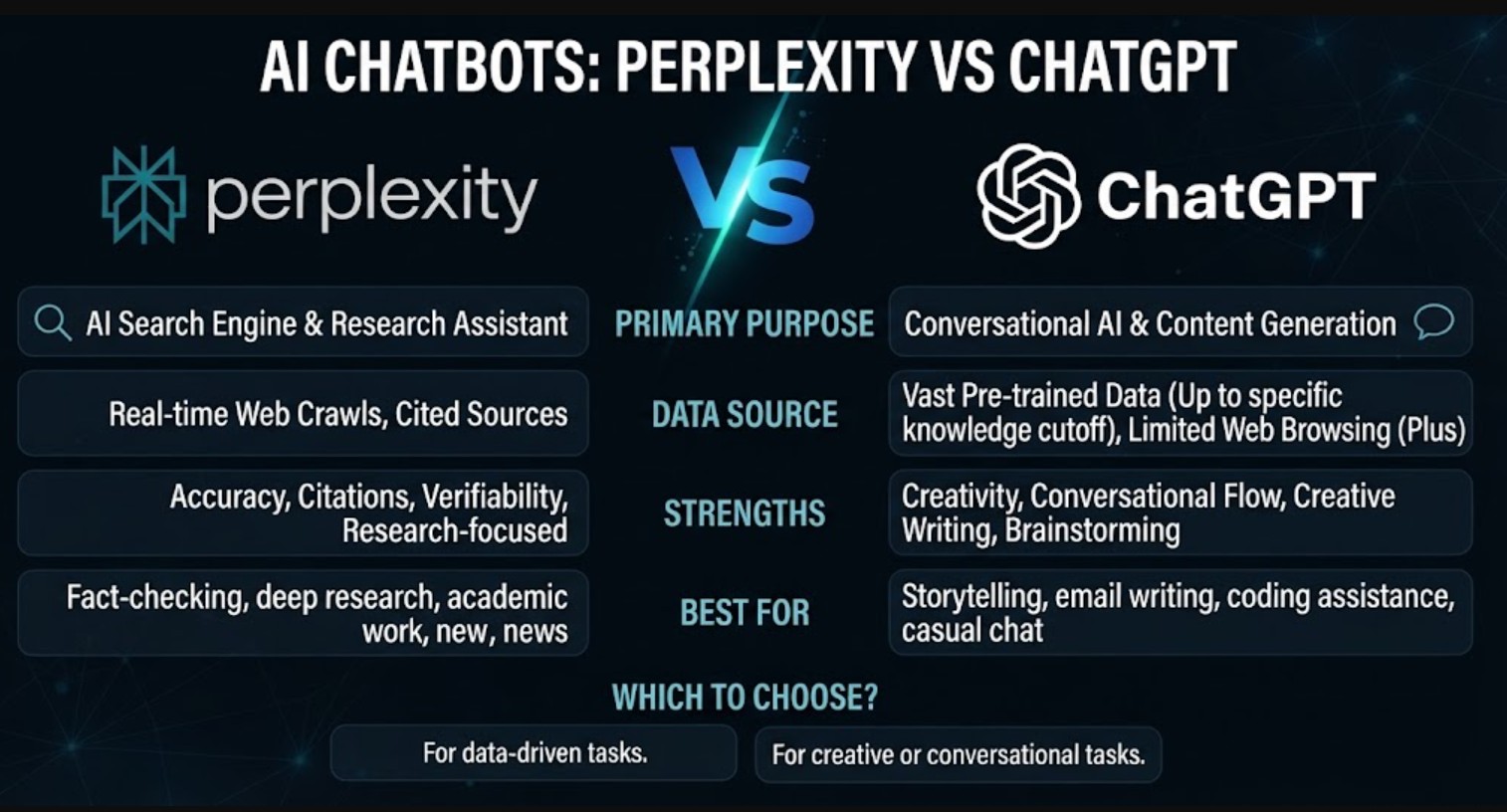
Perplexity is built as an answer engine. You ask a question, it searches the web, reads the results, and writes a short answer with numbered sources next to the claims. Searching is the default behavior, not an add-on. If you’ve used Google, the workflow will feel familiar, except you get a written summary instead of ten blue links.
ChatGPT started as a conversational assistant. Its first job is to talk, reason, draft, and follow instructions across a long thread. It can browse the web, but it decides whether to search. Many replies come from what the model already knows, plus whatever you’ve pasted into the chat.
That difference in starting point explains most of what follows. Perplexity is strongest when you need to find and verify something. ChatGPT is strongest when you need to think through something or produce something.
Neither approach is better in the abstract. A student checking a statistic and a marketer drafting a campaign are doing different jobs, and each tool is shaped for one of them. The rest of this article shows where the lines blur and where they don’t.
Source Citations: How Each Tool Shows Its Work
Citations are the clearest day-to-day difference. Perplexity attaches numbered references to nearly every answer. You can see which websites it used, and you can click through to the original page. For fact-checking, that is a real time-saver.
ChatGPT also shows sources when it uses web search, usually as links or a source list under the reply. When it answers from its own training, there may be no source at all. That is fine for brainstorming or explaining a concept. It is a problem when you need a figure, a date, or a quote you can stand behind.
One caution applies to both tools: a citation doesn’t prove the claim is right. An answer can cite a real page and still summarize it badly, or lean on a weak source. The safe habit is to open the cited page and confirm the sentence says what the AI says it does, especially for health, legal, or financial topics.
- Perplexity: citations are the default and appear throughout the answer.
- ChatGPT: citations depend on whether web search was used for that reply.
- Both: the source can be real while the summary is slightly off, so verify anything important.
Perplexity AI vs ChatGPT Differences in Research and Live Information
For quick research, Perplexity’s flow is hard to beat. You ask, scan a sourced summary, then use follow-up suggestions to narrow the topic. It also has focused search modes and a Deep Research feature that runs many searches and compiles a longer report. That suits market scans, product comparisons, and “what’s the latest on X” questions.
ChatGPT’s research tools have grown a lot too. Its search and deep research features can produce long, structured reports with links. The difference is the feel of the process. ChatGPT works like a collaborator in a long conversation, and you can ask it to restructure findings, challenge its own conclusions, or turn notes into an outline.
For real-time information, such as news, prices, or recent releases, both can pull from the live web. In practice, Perplexity is more consistent about searching every time. With ChatGPT, it helps to say “search the web for this” when freshness matters. Otherwise it may answer from older knowledge.
A simple pattern works well for many people: use Perplexity to gather and verify sources, then paste the key material into ChatGPT to analyze, reframe, or write. The two tools overlap less than their marketing suggests.
Writing, Coding, and Creative Work: Where ChatGPT Leads
When the task is to make something, ChatGPT usually feels more capable. It holds tone across long drafts, follows detailed instructions, and handles multi-step requests such as “rewrite this for a skeptical audience, then shorten it by a third.” Features like Projects, custom GPTs, file analysis, and image generation add to that range.
Coding is another strong area. ChatGPT can explain errors, refactor code, write tests, and work through a problem across many turns. Paid plans add coding-agent tools for larger tasks. Perplexity can answer programming questions and cite documentation, which is useful for looking up syntax or library behavior. It is less of a workspace for building.
Perplexity has been widening its reach as well. Paid tiers offer image generation, file uploads, access to models from several providers, and agent-style tools, including its Comet browser. The gap is narrower than it used to be. Still, if your main goal is drafting, editing, or iterating on a project over days, ChatGPT’s conversation-first design is easier to work in.
Free vs Pro Features: What You Get at Each Price
Both tools let you start free, and both limit what the free tier can do. Perplexity’s free plan covers unlimited basic searches with citations, but only a few advanced “Pro” searches per day. ChatGPT’s free plan gives access to a lighter model with capped messages, uploads, and image generation, and limits tighten at busy times.
At the paid level, the two are close on price. Based on the pricing information available at the time of writing, both offer a standard plan at around $20 per month. Perplexity Pro raises its search and Deep Research limits and lets you choose among several AI models. ChatGPT Plus unlocks flagship models, expanded deep research, Projects, custom GPTs, and coding tools. Both also have premium tiers for heavy users at much higher prices, and ChatGPT has a low-cost tier that may show ads in some regions. For current details, see OpenAI’s official ChatGPT pricing page and Perplexity’s own plans page.
| Perplexity | ChatGPT | |
|---|---|---|
| Free | Unlimited basic searches, a few Pro searches daily | Lighter model, capped messages and uploads |
| Standard paid (~$20/mo) | Unlimited Pro Search, higher Deep Research limits, multiple model options | Flagship models, Projects, custom GPTs, expanded deep research |
| Premium tiers | Max plan with unlimited research and agent tools | Higher-usage Pro tiers for power users |
Prices and limits vary by country and change often, so treat this table as a snapshot, not a quote.
If you mostly look things up, Perplexity’s free plan may be all you need. If you write, code, or build projects regularly, ChatGPT’s paid tier tends to give more room to work. Pay only when you keep hitting a limit on the free version.
Accuracy, Privacy, and Trust: What to Check Before You Rely on Either
Both tools can be wrong, and both can sound sure when they are. This is called hallucination, and it hasn’t gone away in 2026. Perplexity’s citations make mistakes easier to catch, because you can see where a claim came from. ChatGPT is safer when you ask it to show sources or work from documents you provide.
Source quality matters too. Perplexity builds answers from what it finds, so a thin or biased set of pages can produce a thin or biased answer. Check whether the cited sites are authoritative, such as official documentation, peer-reviewed research, or established news outlets, and not low-quality content farms.
Privacy deserves a few minutes of attention. Both companies offer controls over whether your conversations are used to improve their models, and the defaults can differ by plan and by account type. Business and enterprise plans usually have stricter data terms. Don’t paste confidential client information, passwords, or personal records into any consumer AI tool until you have read its current privacy settings.
Which One Should You Use? A Practical Decision Guide
Pick Perplexity if your work centers on finding information. That includes students checking facts, journalists scanning for leads, shoppers comparing products, and professionals who need a quick, sourced briefing. The citation-first layout saves time, and the free plan is generous enough to test it properly.
Pick ChatGPT if your work centers on creating or reasoning. That includes writers, developers, analysts, and anyone who wants one assistant for drafting, brainstorming, file analysis, and long projects. Its range of tools is wider, and its conversation memory suits ongoing work.
Pick both if you can’t decide. Plenty of people pair the free versions for a month and see which one they open more often. If you only pay for one, choose by the task you do most, not by the feature list.
Whichever you choose, keep one habit: open the sources for anything that matters. AI tools save time on the first 80 percent of a task, and a quick check protects the last 20.
Conclusion
Perplexity works like a search engine that writes, and ChatGPT works like an assistant that can search. That one distinction explains most of the differences in citations, research, writing strength, and how each plan is built.
Choose Perplexity when you need fast, sourced answers. Choose ChatGPT when you need drafting, coding, or deeper back-and-forth. Prices are similar, so the right plan depends on the limits you actually hit. Trust either tool only as far as you can check it.
FAQs
1. Is Perplexity better than ChatGPT?
Neither is better overall. Perplexity is better for sourced, up-to-date answers. ChatGPT is better for writing, coding, and long conversations.
2. Is Perplexity AI free to use?
Yes. The free plan includes unlimited basic searches with citations, plus a small daily number of advanced searches. Paid plans raise those limits.
3. Does ChatGPT show sources like Perplexity?
When it searches the web, it shows links to its sources. When it answers from training data, it often doesn’t, so ask it to search and cite if you need references.
4. Which is better for research?
Perplexity is faster for quick, cited lookups. ChatGPT’s deep research suits longer, structured reports. Many people use both, then verify the key claims.
5. Is Perplexity Pro or ChatGPT Plus worth $20 a month?
It depends on your work. Choose Perplexity Pro if you search and fact-check daily. Choose ChatGPT Plus if you write, code, or build projects. Try the free plans first.
