

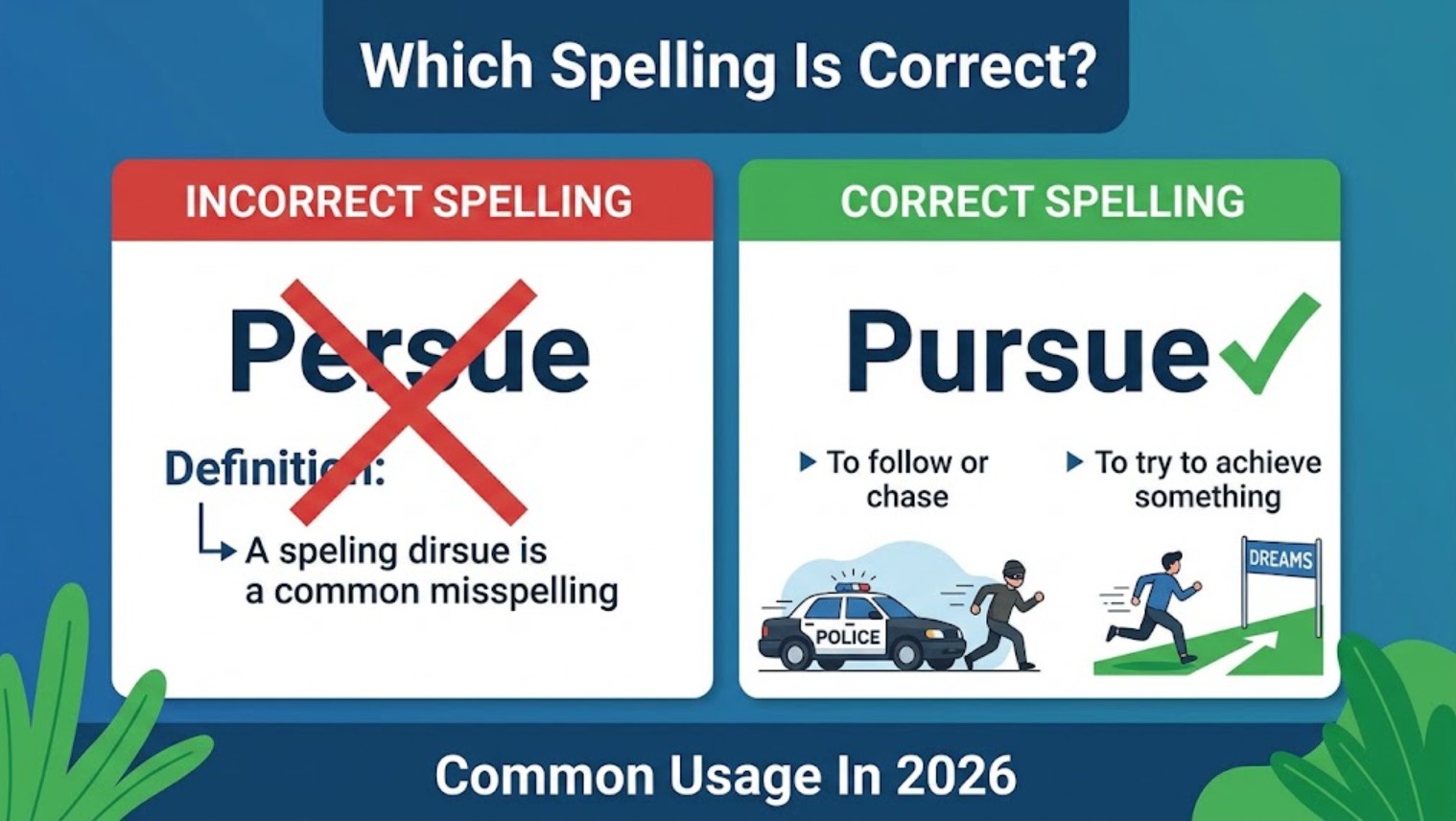
If you have ever wondered whether the correct spelling is persue or pursue, you are not alone. The two forms look very similar, but only one is accepted as the standard English spelling. The correct word is pursue.
“Pursue” is a verb commonly used when talking about following something, trying to achieve a goal, continuing an activity, or chasing someone or something. “Persue,” on the other hand, is a common spelling mistake and should not be used in standard written English.
Persue or Pursue: Which Spelling Is Correct?
The correct spelling is pursue. It is written P-U-R-S-U-E, with “pur” at the beginning and “sue” at the end. The spelling “persue” is incorrect, even though it may look natural because of the way the word is pronounced.
If you are writing an email, essay, application, article, résumé, or any other formal text, always choose pursue. For a reliable definition and examples, you can also check the Cambridge Dictionary entry for pursue, which lists the word’s standard meanings and pronunciation.
The confusion usually comes from pronunciation. Depending on the speaker’s accent, the first syllable can sound closer to “per” than “pur.” This can lead people to spell the word according to how they hear it. However, pronunciation does not change the standard spelling.
Here are some simple examples:
- I want to pursue a career in medicine.
- She decided to pursue her dream of becoming an artist.
- The company plans to pursue new opportunities.
- The police began to pursue the suspect.
- He continued to pursue his goal despite several setbacks.
In every example, pursue is the correct spelling.
What Does Pursue Mean?
The verb pursue has several related meanings. One of the most common is to follow or chase someone or something. For example, if a police officer follows a person who is trying to escape, the officer may be described as pursuing that person.
The word can also describe the effort to achieve something. This meaning is especially common when discussing education, careers, ambitions, goals, and personal interests. Someone may pursue a degree, pursue a career, pursue a dream, or pursue an opportunity.
For example, saying “She wants to pursue a career in engineering” means that she intends to work toward becoming an engineer. Similarly, “He is pursuing his dream” means that he is actively working to achieve something he wants.
Pursue can also mean continuing with an activity, course of action, or subject. A person might pursue an investigation, pursue a particular strategy, or pursue an interest in history.
The meaning therefore depends on the context. In physical situations, it can mean following or chasing. In more abstract situations, it usually refers to making an effort to achieve or continue something.
How to Use Pursue in a Sentence
One of the easiest ways to understand pursue is to look at the words that commonly follow it. The verb is frequently used with words such as career, goal, dream, ambition, opportunity, education, degree, interest, and relationship.
For example, you could say, “After finishing school, Maria decided to pursue a degree in business.” Here, pursue means that Maria chose to work toward obtaining a business degree.
You could also say, “The company is pursuing new customers in international markets.” In this sentence, the company is actively trying to reach or gain new customers. The word does not necessarily involve physically following anything.
Here are more examples:
Career:
He decided to pursue a career in software development.
Education:
She plans to pursue a master’s degree after graduation.
Goal:
They continued to pursue their goal despite the difficulties.
Dream:
He left his job to pursue his dream of becoming a musician.
Opportunity:
The business is pursuing a new investment opportunity.
Interest:
She decided to pursue her interest in photography.
Investigation:
The authorities continued to pursue the investigation.
These examples show why pursue is such a useful English verb. It can describe both physical action and determined effort toward an objective.
Pursue vs Pursuit: What Is the Difference?
Another common source of confusion is the difference between pursue and pursuit. Although they are closely related, they have different grammatical roles.
Pursue is a verb. It describes an action.
For example:
She wants to pursue a career in law.
The person is performing the action of working toward a career, so pursue is appropriate.
Pursuit is a noun. It describes the act or process of pursuing something.
For example:
Her pursuit of a legal career required years of study.
Here, “pursuit” is the name of the activity or effort.
A simple way to remember the difference is:
- Pursue = action
- Pursuit = the act or process
There is also the noun pursuer, which refers to someone who pursues another person or thing.
For example:
The pursuer followed the runner through the streets.
These words belong to the same word family, which makes them useful for remembering the correct spelling of pursue. If you remember “pursuit” and “pursuer,” it becomes easier to avoid writing “persue.”
Why Do People Spell Pursue as Persue?
The spelling persue is a common error because English spelling and pronunciation do not always match perfectly. When people hear a word rather than see it written, they may choose a spelling that seems to match its pronunciation.
The beginning of “pursue” can be particularly confusing. Depending on someone’s accent, the first part may not sound exactly like the spelling suggests. As a result, a writer may instinctively type “persue.”
Another reason is that English contains many words beginning with per-, such as “perform,” “permit,” “persist,” and “perfect.” This familiar spelling pattern may cause people to incorrectly transfer it to “pursue.”
However, there is a useful way to remember the correct form. Think of the related words pursuit and pursuer. Both retain the “pur-su” spelling. If you remember this word family, you are less likely to accidentally write “persue.”
It is also worth remembering that spell-checkers may catch the mistake in many applications, but they should not be your only method of checking written English. Knowing the correct spelling yourself is especially important when writing formal documents or publishing content online.
Common Mistakes With Pursue
The most obvious mistake is replacing u with e and writing persue. This is incorrect in standard English.
Another mistake is confusing pursue with pursuit. For example, “I want to pursuit my dream” is incorrect because “pursuit” is a noun. The correct sentence is “I want to pursue my dream.”
The same issue appears in phrases involving education and careers. You should say “pursue a degree” and “pursue a career,” not “pursuit a degree” or “pursuit a career.”
It is also important not to assume that pursue always means physically chasing something. In modern English, the word is very commonly used in an abstract sense. People pursue goals, careers, opportunities, interests, ambitions, and dreams.
A useful correction guide is:
| Incorrect | Correct |
|---|---|
| persue | pursue |
| persuing | pursuing |
| persued | pursued |
| persues | pursues |
| pursuit a career | pursue a career |
| pursue of a goal | pursuit of a goal |
Notice that the spelling changes slightly when the word takes different grammatical forms. The base verb is pursue, while the present participle is pursuing, the past tense is pursued, and the third-person singular form is pursues.
Conclusion
When deciding between persue or pursue, the answer is clear: pursue is the correct spelling. The word can mean to follow or chase something, but it is also widely used when talking about goals, careers, education, dreams, opportunities, and ambitions.
Remember the spelling P-U-R-S-U-E and connect it with related words such as pursuit and pursuer. This simple association can help prevent one of the most common spelling mistakes involving the word.
Whether you are writing about pursuing a career, pursuing an education, or pursuing a personal goal, pursue is the form you should use.
FAQs
Is “persue” a correct word?
No. Persue is a misspelling. The correct spelling is pursue.
What does pursue mean?
Pursue can mean to follow or chase someone or something. It can also mean to work toward achieving a goal, career, dream, opportunity, or ambition.
Is it “pursue a career” or “pursuit a career”?
The correct phrase is “pursue a career.” Pursue is a verb, while pursuit is a noun.
What is the difference between pursue and pursuit?
Pursue is a verb describing an action, while pursuit is a noun describing the act or process of pursuing something.
For More Visit Star Bio Trend
