

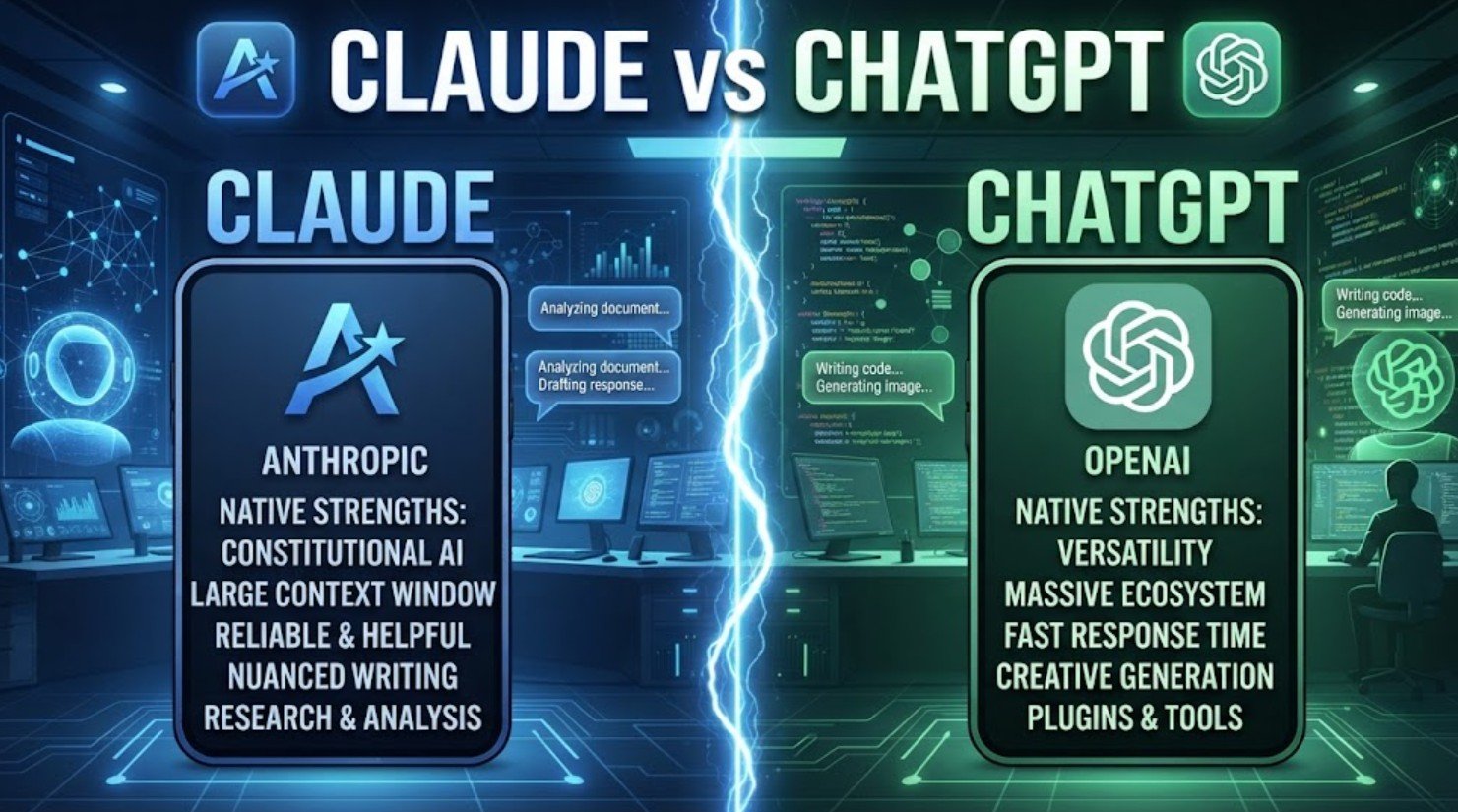
When comparing Claude vs ChatGPT, the choice comes down to your primary use case: choose Anthropic’s Claude if your priority is natural human-like writing, deep document analysis, and precise multi-file coding; choose OpenAI’s ChatGPT if you need an all-in-one assistant with real-time web browsing, voice chat, and image generation.
Both platforms represent the leading edge of generative artificial intelligence, but they follow fundamentally different design philosophies. Anthropic built Claude to function as an focused workspace tool for writing and programming, while OpenAI developed ChatGPT into a multi-purpose digital assistant capable of handling voice conversations, internet research, and image creation under a single roof.
Claude vs ChatGPT: Direct Comparison Table
| Feature / Metric | Anthropic Claude | OpenAI ChatGPT | Winner |
|---|---|---|---|
| Long-Form Writing & Tone | Natural, human cadence; zero generic filler | Adaptable, but leans formulaic without custom prompts | Claude |
| Complex Coding & Debugging | High accuracy on multi-file logic & terminal tasks | Excellent code execution in Python sandboxes | Claude |
| Web Browsing & Live Search | Limited native search; relies on uploaded files | Fast live web browsing & real-time search | ChatGPT |
| Multimodal Tools (Voice/Image) | Document/image analysis only; no voice or image gen | Advanced Voice mode & integrated DALL-E image gen | ChatGPT |
| Context Window (Paid Tier) | Up to 1 Million tokens (book-length processing) | 128k to 256k tokens with high reasoning buffers | Claude |
| Pricing Structure | Free tier; $20/month for Pro | Free tier; $20/month for Plus | Tie |
Writing Quality and Tone: Why Writers Prefer Claude
Evaluating writing style highlights the biggest daily difference between Claude vs chatgpt. For content creators, editors, and academic researchers, Claude consistently produces prose that sounds more natural and less like machine-generated text.
ChatGPT defaults to a predictable corporate structure. It heavily favors transitions like “furthermore”, “in summary”, and “it is important to remember”, often organizing simple thoughts into unnecessary bullet lists. While you can condition ChatGPT with detailed system prompts to sound more conversational, it takes extra effort.
Claude writes with a varied sentence cadence, understands subtle tone shifts, and maintains voice consistency across long articles. It also features Artifacts, a dedicated side-by-side workspace that displays drafts, code snippets, or markdown documents in a separate window next to your chat. This makes drafting, reviewing, and editing large documents far cleaner than scrolling through a continuous chat stream.
Coding and Technical Logic: The Developer Benchmark
For software engineering and programming workflows, comparing Claude vs ChatGPT reveals strengths in two different areas:
- Architecture and Debugging (Claude): On software engineering evaluations like SWE-bench, Claude models lead the market in multi-file codebase understanding. When given a complex bug report, Claude analyzes the root cause across several interconnected files instead of just fixing the immediate syntax error. Its native coding agent, Claude Code, can navigate repositories in your terminal, write patches, and prepare pull requests directly.
- Code Execution and Sandboxing (ChatGPT): ChatGPT holds a distinct advantage when you need to run code immediately. Its Advanced Data Analysis feature includes a built-in Python environment that can execute scripts, analyze uploaded CSV files, generate graphs, and return downloadable files in real time.
If your work requires writing production-ready backend logic, refactoring legacy scripts, or building web applications, Claude is the superior developer tool. If your goal is running rapid data analysis on spreadsheets or charting financial figures, ChatGPT is more convenient.
Multimodal Features: Where ChatGPT Dominates
While Claude wins on text nuance and coding depth, ChatGPT easily wins on feature variety. If you need an AI tool that handles multiple media formats, OpenAI offers a broader ecosystem.
- Advanced Voice Mode: ChatGPT provides ultra-low latency voice conversations that allow you to interrupt, change accents, and hold natural spoken discussions. Claude lacks a comparable real-time voice mode.
- Integrated Image Creation: ChatGPT connects directly to native image generation engines, allowing you to create concept art, social media thumbnails, and diagrams from text prompts. Claude cannot generate images; it only interprets images you upload.
- Live Web Research: ChatGPT searches the live web automatically when asked about breaking news, current stock prices, or new software releases, complete with direct URL citations. Claude relies primarily on its underlying training data and files you upload to the conversation.
Context Window and File Handling
Both platforms handle massive files, but their approach to memory sets them apart.
Claude allows users to upload full code repositories, book-length PDFs, and dense technical manuals with an expansive context window scaling up to one million tokens. More importantly, its retrieval accuracy across long documents remains exceptionally high, so it rarely misses details buried on page 200 of a legal brief.
ChatGPT handles standard file uploads smoothly, but it dynamically compresses and retrieves text chunks for reasoning rather than processing the entire text at once. For analyzing five-hundred-page documents in one pass, Claude delivers more reliable cross-referencing.
Pricing: Free vs. Paid Subscriptions
Both platforms price their standard consumer subscriptions identically at twenty dollars per month:
- Claude Pro ($20/month): Grants access to flagship models (Sonnet and Opus), five times more usage compared to the free tier, access to Projects for organizing team documents, and higher memory priority during peak hours.
- ChatGPT Plus ($20/month): Grants access to GPT-4o, advanced reasoning models (o1 series), unlimited live web search, Advanced Voice mode, DALL-E image generation, and custom GPT builders.
Both companies offer generous free tiers. If you are undecided, testing both with your daily workflow costs nothing before committing to a paid plan.
Final Verdict: Which AI Model Wins?
Choosing between claude vs chatgpt depends entirely on what your daily workload requires:
- Pick Claude if: You spend most of your day writing articles, drafting legal contracts, coding complex software, or summarizing dense academic research. Its natural writing style, Artifacts workspace, and superior coding logic make it the better professional thinking partner.
- Pick ChatGPT if: You want a versatile, all-in-one assistant that can search the internet for live data, generate visual graphics, carry on spoken voice conversations, and analyze data spreadsheets in an interactive sandbox.
