

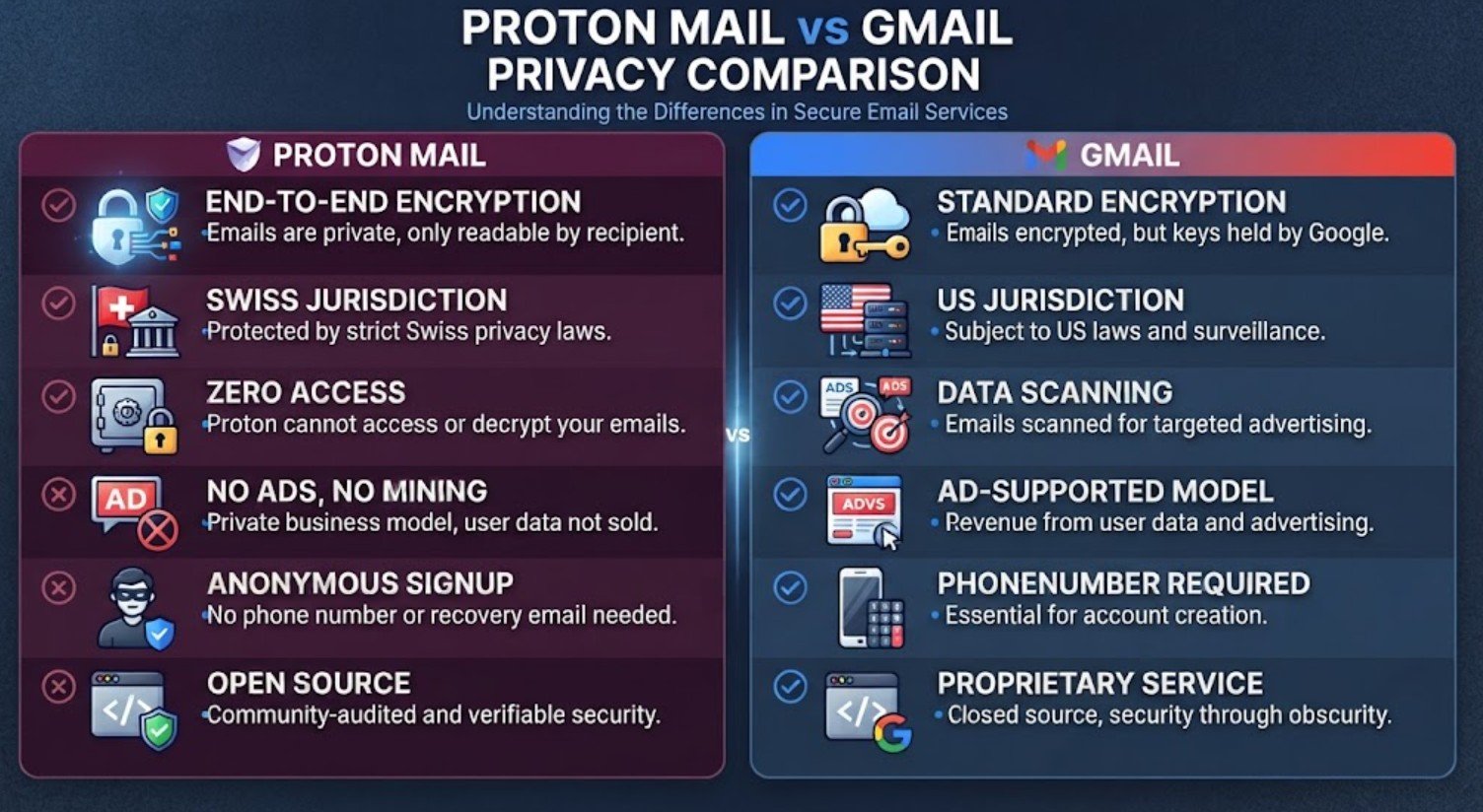
Comparing Proton Mail vs Gmail privacy comes down to zero-access encryption versus ad-driven data collection: Proton Mail provides genuine, mathematically verified privacy through default end-to-end encryption under strict Swiss legal jurisdiction, while Gmail scans email metadata, logs user behavior across Google services, and holds the private encryption keys to your entire inbox.
Google’s business model depends on gathering user data to build advertising profiles, whereas Proton operates on an encrypted subscription model where engineers cannot read your messages even under court order.
Proton Mail vs Gmail Privacy: Quick Comparison Table
| Privacy & Security Feature | Proton Mail | Google Gmail | Advantage |
|---|---|---|---|
| End-to-End Encryption (E2EE) | Default for Proton-to-Proton & password-locked emails | None by default; S/MIME restricted to enterprise accounts | Proton Mail |
| Zero-Access Architecture | Yes (encrypted at rest; Proton has zero decryption keys) | No (Google holds encryption keys and can access email contents) | Proton Mail |
| Legal Jurisdiction | Switzerland (Strict Swiss FADP & Cantonal courts) | United States (Subject to US CLOUD Act, FISA, and FBI subpoenas) | Proton Mail |
| Ad Tracking & Profiling | Zero ads, zero trackers, no cross-site behavior profiling | Tracks user activity across Search, YouTube, and Chrome | Proton Mail |
| Account Creation Anonymity | No phone number or personal identity required | Phone number verification almost always required | Proton Mail |
| Open-Source Codebase | Yes (All web, desktop, and mobile apps are open-source) | No (Proprietary Google closed-source software) | Proton Mail |
How Encryption Works: Zero-Access vs. Google’s Key Control
The fundamental technical difference in Proton Mail vs Gmail privacy lies in how each provider handles cryptographic keys.
Gmail uses standard Transport Layer Security (TLS) when emails travel across the web, along with standard encryption on its physical servers. However, Google holds the master decryption keys. This means Google’s automated algorithms can scan your purchase receipts, travel confirmations, and newsletters to populate Google Calendar, Google Maps, and targeted ad networks. More importantly, if a court serves Google with a valid legal warrant, Google can decrypt and hand over your entire email history in plain text.
Proton Mail uses Zero-Access Encryption and client-side end-to-end encryption built on open-source OpenPGP standards. Your messages are encrypted on your local device before they ever hit Proton’s servers in Switzerland. Because only you hold the private decryption key linked to your password, neither Proton’s staff nor government agencies can read your email contents, view attached documents, or decrypt your stored messages.
Jurisdiction and Government Surveillance: Swiss Law vs. US Cloud Act
Legal jurisdiction plays a critical role in evaluating Proton Mail vs Gmail privacy.
Gmail is operated by an American corporation subject to United States federal jurisdiction. Under legal instruments like the US CLOUD Act and the Foreign Intelligence Surveillance Act (FISA), American intelligence agencies and law enforcement can compel Google to wiretap communications, monitor incoming emails, or turn over stored account archives without informing the user.
Proton Mail is headquartered in Geneva, Switzerland, and houses all primary server infrastructure in hardened subterranean data centers beneath the Swiss Alps. Switzerland operates outside both the European Union and the United States, meaning American legal orders, national security letters, and foreign subpoenas have zero legal standing in Swiss courts. Foreign agencies must petition a Swiss federal judge to prove a serious criminal offense under Swiss law before any account metadata can be requested, giving users the world’s strongest legal privacy shield.
Tracking, Metadata, and Cross-Platform Profiling
Even if a company claims it no longer scans emails directly for advertising, metadata reveals an enormous amount about your daily life.
Gmail functions as an entry gate to the broader Google ecosystem. When you use Gmail, Google connects your email identity to:
- Your Google Search queries and location data.
- Your YouTube viewing history.
- Android device activity and Chrome browser browsing habits.
- Online shopping receipts and automated purchase tracking.
Proton Mail logs zero personal tracking metrics. The service strips tracking pixels automatically from incoming marketing emails, preventing senders from knowing when you opened a message or where you were located. Furthermore, Proton does not require personal identifying information like a phone number to register an account, making it possible to run a completely anonymous inbox through Proton Mail and the Tor network.
Usability and Daily Ecosystem Integration
While Proton Mail clearly wins on security, Gmail holds a convenience advantage for users who rely on integrated office software.
- Gmail Convenience: Gmail integrates seamlessly with Google Drive, Docs, Sheets, and third-party web apps. Searching your inbox is nearly instantaneous because Google maintains a searchable plaintext database of every email you have ever received.
- Proton Mail Workaround: Because Proton encrypts all stored emails on the server, searching through the body text of your messages requires building a client-side encrypted search index inside your local web browser or mobile app. Proton also offers encrypted calendar storage (Proton Calendar), cloud storage (Proton Drive), and a virtual private network (Proton VPN), but its third-party app ecosystem is naturally more restricted to protect security.
Cost Comparison: Free vs. Paid Privacy
Both platforms provide free access tiers, but their business funding structures are fundamentally opposed:
- Gmail Free Model: Gmail provides fifteen gigabytes of storage across Gmail, Google Drive, and Google Photos for free. You pay with your attention and your data profile, which fuels Google’s advertising engine.
- Proton Mail Model: Proton provides a clean, ad-free free account with one gigabyte of storage. To unlock custom domain names, unlimited email aliases, and larger cloud drives, Proton offers paid personal tiers starting around four dollars per month. Because users pay directly for the service, Proton has zero commercial incentive to collect, analyze, or monetize your inbox.
Final Verdict: Which Service Should You Use?
Choosing between Proton Mail vs Gmail privacy depends on whether you prioritize convenience or data ownership:
- Choose Proton Mail if: You believe your private communications, medical receipts, financial statements, and business correspondence should belong to you alone. Its zero-access encryption, open-source software, and Swiss legal protection make it the best email service for digital privacy.
- Choose Gmail if: You rely heavily on Google Workspace collaborations, use Android auto-sync features daily, and are comfortable exchanging metadata privacy for seamless search integration and free storage.
