

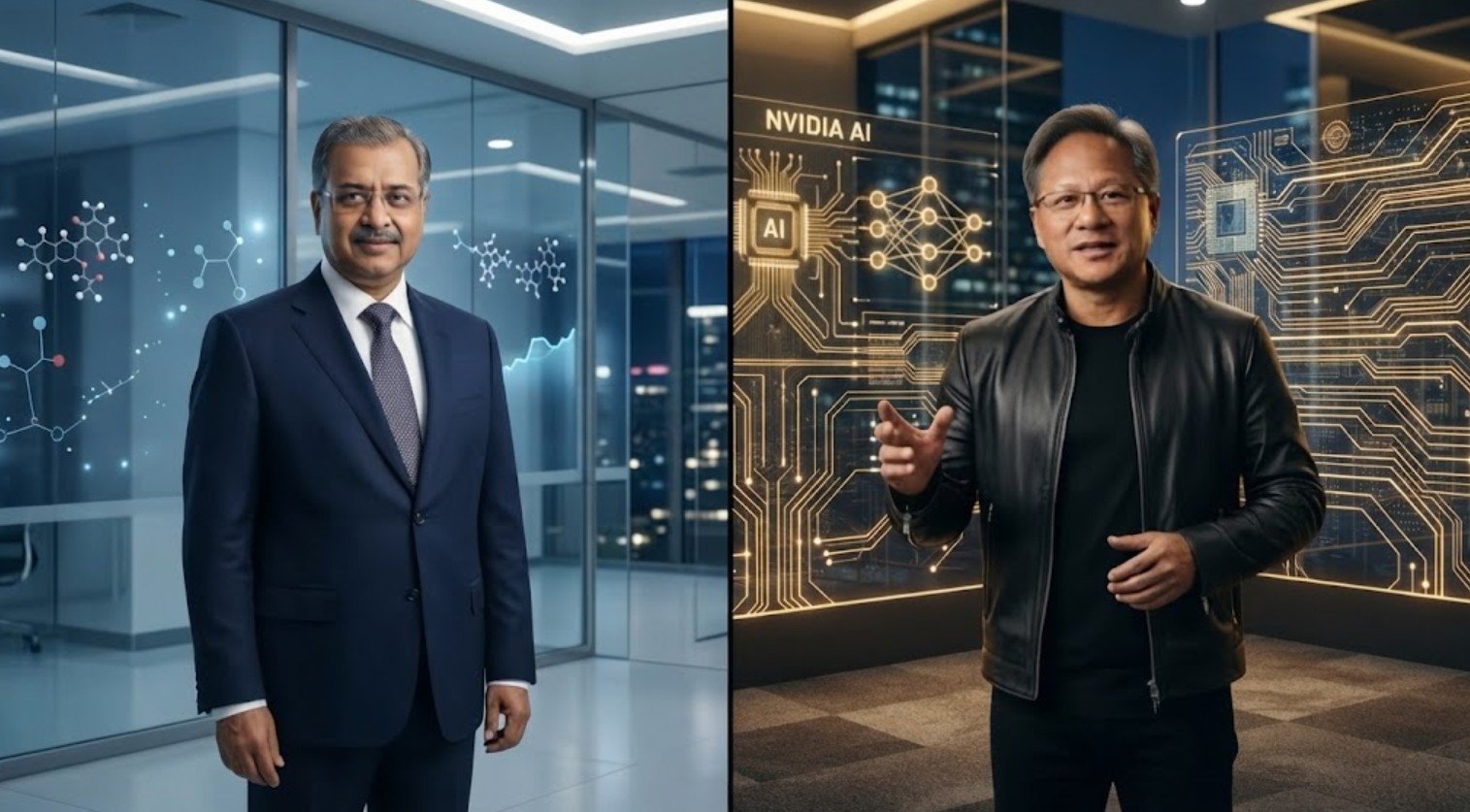
Search for Dilip Shanghvi and Jensen Huang together and you will notice something quickly. They don’t share a company, a deal or a stage. One built India’s largest drug maker. The other built the company whose chips power much of today’s artificial intelligence.
So why put them side by side? Because their stories answer questions many readers keep asking. How does a founder grow a business from almost nothing? What separates a long-term builder from a lucky one? And how do two people in very different fields end up on the same lists of the world’s richest entrepreneurs?
This article compares the two men using publicly available facts. It doesn’t invent a partnership that doesn’t exist. It simply looks at what each one did, how they did it, and what the rest of us can learn.
Who Are Dilip Shanghvi and Jensen Huang?
Dilip Shanghvi is the founder of Sun Pharmaceutical Industries, based in India. He was born on 1 October 1955 in Amreli, Gujarat, and grew up in Kolkata. He studied commerce at the University of Calcutta and entered the pharmaceutical trade rather than the lab. Over four decades he turned a one-plant business into a global generics and specialty medicines company.
Jensen Huang is the co-founder, president and CEO of Nvidia. He was born in Taipei, Taiwan, on 17 February 1963 and moved to the United States as a child. He trained as an electrical engineer, worked in chip design, and started Nvidia in 1993 with two colleagues He has been the CEO ever since, which is rare for a company that has been through so many shifts.
Both men are still closely tied to the companies they started. That matters. Neither one is a retired name on a plaque. Their decisions today still shape how their firms invest, hire and compete, which is why people follow them so closely.
Humble Starts That Shaped Both Founders
Neither Dilip Shanghvi nor Jensen Huang began with a big cushion. Shanghvi founded Sun Pharma in 1983 with a small loan from his father. The first product line focused on psychiatric medicines, a narrow niche that larger firms were not chasing at the time. Production started at a single facility in Vapi, Gujarat.
Huang’s early years were less settled. His family moved between countries, and at age nine he was sent to the United States to live with an uncle. A first school in Kentucky was a rough fit, and he later joined his parents in Oregon. He skipped two grades, finished high school at 16, and earned his engineering degree at Oregon State University in 1984. He completed a master’s at Stanford in 1992 through night classes while holding a full-time job.
Both stories share a pattern. Each founder began in a small, specific corner of a bigger market. Each also learned the business from the ground up before trying to grow it. That early discipline shows up later in how carefully both companies make big bets.
How Sun Pharma and Nvidia Were Built
Sun Pharma grew in steps. After the Vapi plant, the company expanded into more therapy areas and moved into the United States market. The defining move came in 2014, when Sun Pharma acquired Ranbaxy Laboratories in a deal worth about $4 billion. That purchase made it India’s largest pharmaceutical company. Later deals added US-based assets such as Ocular Technologies in 2016 and Concert Pharmaceuticals in 2023.
The years after the Ranbaxy deal weren’t easy. Profits fell between 2014 and 2018 as the company dealt with regulatory problems and the work of absorbing a big acquisition. Shanghvi stayed with the strategy, and the group kept growing in specialty medicines. It’s a useful reminder that large deals pay off slowly and often look uncomfortable in the middle.
Nvidia’s path was just as bumpy. The three founders met at a Denny’s restaurant in East San Jose and incorporated the company on 5 April 1993. Early on, it came close to failing. A $5 million investment from Sega helped it survive, and the RIVA 128 graphics chip in 1997 gave it real traction. Huang has often described those years as a constant race against running out of money.
Two decades later, the same chips that rendered video games turned out to be well suited to training machine learning models. In October 2025, Nvidia became the first public company to pass a $5 trillion market value. That outcome grew out of a long run of technical bets, not a single lucky release.
Leadership Style: Quiet Operator vs. Hands-On Visionary
Shanghvi is known for staying out of the spotlight. He rarely gives interviews, and his public image is that of a patient operator who prefers acquisitions and steady expansion to loud announcements. Outside Sun Pharma, he has taken on public-service roles. He joined the Reserve Bank of India’s central board in 2018, chairs the board of governors at IIT Bombay, and became a trustee of the Rhodes Scholarship programme in 2017.
Huang is far more visible. He appears on stage in his trademark leather jacket and speaks openly about technology and strategy. Yet his management habits are quite practical. He has no fixed office and moves around headquarters, using whichever conference room is free. He runs a flat structure, with around 60 direct reports as of late 2024, so information reaches him without many layers in between.
The styles differ, but the logic is similar. Both men keep decision-making close to them. Both rely on long-term thinking rather than quarterly moves. And both are comfortable making large commitments when they believe the industry is about to shift.
Wealth and Rankings: What the Numbers Show
Wealth rankings give a rough way to compare how far each founder has come, though the figures change daily with share prices. Forbes estimated Dilip Shanghvi’s net worth at about $28.9 billion in May 2025, which placed him fifth on India’s rich list. Forbes put Jensen Huang’s net worth above $200 billion in 2026, ranking him around seventh in the world.
| Dilip Shanghvi | Jensen Huang | |
|---|---|---|
| Company | Sun Pharmaceutical Industries | Nvidia |
| Founded | 1983 | 1993 |
| Industry | Pharmaceuticals | Semiconductors and computing |
| Home base | India | United States |
| Notable honors | Padma Shri (2016), EY Entrepreneur of the Year India (2005) | IEEE Medal of Honor (2026), Queen Elizabeth Prize for Engineering (2025) |
| Net worth (Forbes estimate) | About $28.9 billion (May 2025) | Over $200 billion (2026) |
Treat these as snapshots, not fixed facts. Both fortunes are tied mostly to stock holdings, so they rise and fall with the market. The gap between them also says more about the size of the industries than about the skill of the founders. Global AI infrastructure spending has been growing at a pace few other sectors can match, while pharma tends to reward patience over speed.
Where Pharma and Chips Meet
The worlds of Dilip Shanghvi and Jensen Huang do overlap in one practical area: drug discovery. Finding a new medicine is slow and costly, and much of the early work involves screening huge numbers of molecules. Computing power helps with that. Nvidia says its BioNeMo platform offers models, tools and datasets for tasks such as molecular design, virtual screening and protein structure prediction. You can read how the company describes its work on Nvidia’s healthcare and life sciences page.
To be clear, there is no publicly announced partnership between Sun Pharma and Nvidia that ties the two founders together. The link is an industry trend, not a deal. Pharmaceutical companies of every size are testing how AI and faster computing can shorten the early research stage, and chip makers are building products aimed at that demand.
For a company like Sun Pharma, which makes both generic and specialty medicines, the near-term value is likely to sit in manufacturing, quality checks and research support rather than in headline discoveries. For Nvidia, life sciences is one of many industries it wants to serve. Readers should view this crossover as a trend to watch rather than a story already written.
What Founders and Readers Can Take From Their Stories
First, start narrow. Shanghvi began with psychiatric drugs, a small and specific segment. Huang began with graphics chips for a young PC gaming market. Both then expanded from a position of strength instead of trying to do everything at once.
Second, expect a long middle stretch. Sun Pharma’s profits dipped after the Ranbaxy deal. Nvidia nearly ran out of cash in its early years. Neither company grew in a straight line. The founders held their course through the uncomfortable years, and that patience is a big part of the final result.
Third, give back. Huang and his wife, Lori, set up the Jen-Hsun & Lori Huang Foundation in 2007, which has grown into a large philanthropic vehicle. Shanghvi’s contributions are more visible through institutional roles at IIT Bombay and the Rhodes programme. Different routes, but both point to a belief that success should feed something larger than a balance sheet.
Conclusion
The comparison of Dilip Shanghvi and Jensen Huang isn’t about who earned more or whose company is bigger. It’s about two founders who started small, stayed with their companies for decades, and built something durable in fields that move at very different speeds.
Shanghvi shows what steady acquisitions and quiet execution can do in pharma. Huang shows what happens when a long-term technical bet meets the right moment. Their paths don’t cross in any formal way, but the habits behind them, such as focus, patience and willingness to take big swings, are easy to recognise and worth borrowing.
FAQs
1. Have Dilip Shanghvi and Jensen Huang worked together? No public partnership or joint project between them has been announced. They lead companies in different industries, and the comparison is based on their separate careers.
2. Who is richer, Dilip Shanghvi or Jensen Huang? Jensen Huang, by a wide margin. Forbes estimated his net worth above $200 billion in 2026, while Dilip Shanghvi was estimated at about $28.9 billion in May 2025. Both numbers move with share prices.
3. What company did Dilip Shanghvi found? He founded Sun Pharmaceutical Industries in 1983 in Gujarat, India. It later became the country’s largest pharmaceutical company after acquiring Ranbaxy in 2014.
4. What company did Jensen Huang start? He co-founded Nvidia in 1993 with Chris Malachowsky and Curtis Priem and has served as its CEO since the start. Nvidia became the first public company to pass $5 trillion in market value in October 2025.
5. Is Nvidia involved in drug discovery? Yes, in a supporting role. Nvidia offers platforms such as BioNeMo for molecular design and protein structure prediction, which pharmaceutical researchers can use. It doesn’t develop drugs itself.
Net worth figures come from Forbes estimates reported on public profiles and change with market prices. Check current numbers before quoting them.
